
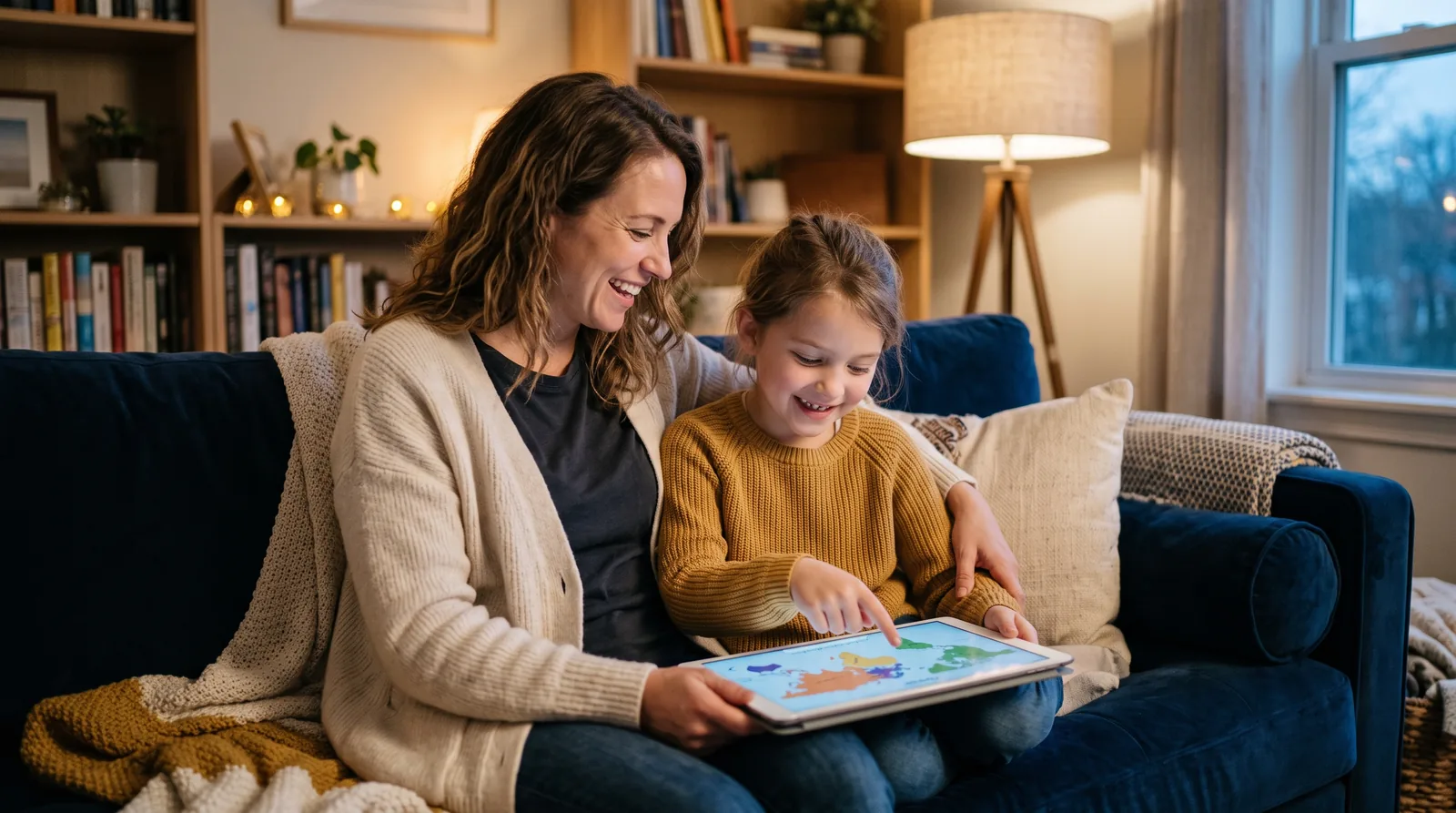
If your child just asked why two countries are fighting, the short answer is: tell them the truth, in small enough pieces that they can hold it. Say what's happening in one or two plain sentences, leave out graphic detail, and reassure them they're safe before you explain anything else. Then let their questions, not the news cycle, decide how far the conversation goes.
That's the version you can use tonight. The rest of this guide covers how to adjust it by age, what to actually say when the follow-up questions get harder ("but why can't they just stop?"), and how to tell the difference between a curious kid and an anxious one.
Find out what they already know, first
Before you explain anything, ask a question instead: "What have you heard about that?" Kids pick up fragments from the school bus, a classmate, a headline glimpsed over your shoulder, or a video that autoplayed before the one they meant to watch. Those fragments are often wrong, exaggerated, or missing context entirely.
Starting with their version does two things. It tells you exactly how much correcting you actually need to do, and it tells you how worried they already are, which changes how you pace the rest of the conversation. A child who asks with genuine curiosity needs a different answer than one who's been quietly worried for two days.
"Why are those countries fighting?"
"Is that a war on the news?"
"Why can't people just get along?"
How much to say, by age (8 to 12)
Most general parenting advice lumps "elementary schoolers" and "tweens" into one wide band. In practice, an 8 year old and a 12 year old need noticeably different amounts of detail. Here's how that split actually plays out:
| Ages 8 to 9 | Ages 10 to 12 |
|---|---|
| What they needShort, factual, safety first. One or two sentences is often enough. | What they needMore context and room to ask follow-up questions. They can handle "it's complicated." |
| Sample line"There's a disagreement between two countries far from here. Grown-ups are working on it, and you're safe." | Sample line"They disagree about land and who's in charge, and it's turned into fighting. It's not a simple problem, and people are trying to end it." |
| Good next stepDraw a picture, point to the place on a map, ask if they have more questions later. | Good next stepLook up one fact together, talk about what peacemakers actually do, revisit the topic over a few days. |
What to actually say when they ask "why are they fighting?"
This is the question that trips most parents up, because the honest answer is almost always "it's complicated", and that alone isn't satisfying to a kid who wants a reason. What works better is naming the real, recurring causes in plain language, without picking a side or turning it into a lecture:
- Land and resources. "Sometimes countries both want the same land, water, or resources, and can't agree on who it belongs to."
- Power and control. "Sometimes one group wants more control over an area, and the other group won't allow it."
- Protecting their people. "Sometimes a country is defending its own borders or citizens from being attacked."
- Differences in belief or government. "Sometimes two groups disagree deeply about how things should be run, or what they believe, and haven't found a way to settle it peacefully."
You don't need to identify which cause applies to a specific real-world conflict in detail, especially with younger kids. Naming the categories gives an 8 to 12 year old a framework they can reuse the next time a new conflict is in the news, instead of a one-off explanation that doesn't generalize.
If you don't know the answer
Say so. "That's a good question, I'm not totally sure, let's look it up together." Kids don't need you to be an expert. Modeling how to find a reliable answer is worth more than a guess dressed up as certainty.
What not to do
Don't lead with graphic detail
Casualty counts, images of destruction, or vivid violence aren't necessary for a child to understand that a conflict is serious.
Don't dismiss the question
"Don't worry about it" tends to increase anxiety, not lower it. Kids fill silence with their own, often worse, imagination.
Don't leave the news running in the background
Rolling coverage repeats the same footage on a loop. A child catching fragments of it without context is worse than a calm conversation.
Don't process your own fear out loud with them
Kids take their emotional cues from you. Work through your own reaction first, even just for a few minutes, before you sit down to talk.
What about screens and social media?
This is the part most guides on this topic skip, and it matters more than the news itself now. Kids rarely encounter war coverage on the evening news anymore. They encounter it as an unfiltered ten-second clip on a feed, often with no context, sometimes shown to them by a friend at school before you know it exists.
Two things help. First, ask specifically: "Have you seen any videos about it, not just heard about it?" Footage can be more upsetting than a conversation or a headline, and kids often don't volunteer that they've seen it unless asked directly. Second, if evenings already feel like a battle over the tablet, that's worth addressing on its own, since a tired, overstimulated kid processes scary news worse than a calm one. A screen-free wind-down routine, like a workbook they actually want to fill in instead of scroll through, can take some of the pressure off that particular fight.
Signs your child is anxious, not just curious
A single round of questions followed by them moving on to something else is normal and healthy. Watch instead for a pattern that lasts more than a week or two:
- Repeating the same question over and over, seeking reassurance rather than information
- New trouble falling asleep, nightmares, or wanting to sleep in your room
- Avoiding school, friends, or activities they normally enjoy
- Physical complaints like stomachaches or headaches with no other explanation
- Becoming unusually clingy or irritable
One or two of these for a few days is a normal reaction to unsettling news. If several persist for more than two or three weeks, it's worth a conversation with your child's teacher, school counselor, or pediatrician.
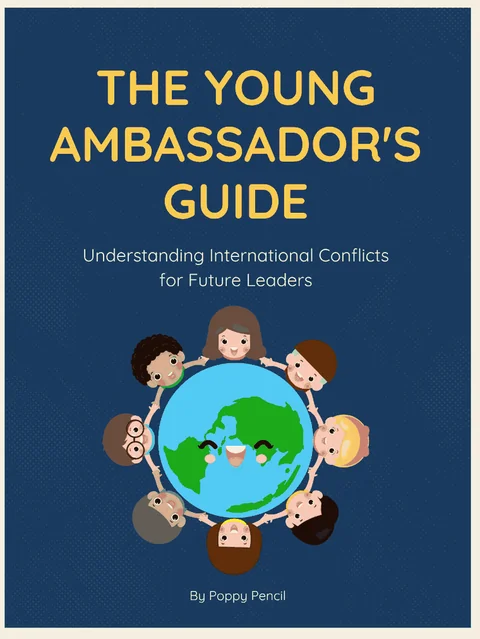
Turn this into an ongoing habit, not a one-time talk
The Young Ambassador's Guide gives kids ages 8 to 12 a structured, hands-on way to keep exploring these questions long after tonight's conversation ends.
Making it a habit, not a one-time talk
The first conversation is rarely the last one. World news doesn't pause, and kids' questions tend to resurface in new forms as they get older. What actually builds resilience isn't having one perfect answer ready, it's showing your child, repeatedly, that big questions are safe to bring to you and worth thinking through carefully rather than reacting to.
That's easier to sustain with some structure. Kids ages 8 to 12 in particular respond well to a format that feels less like a lecture and more like something they're doing themselves, whether that's a discussion habit, a current-events journal, or a hands-on program built around exactly this kind of question. If the conversation turns to families who have had to leave home because of conflict, our guide to explaining what a refugee is picks up from here, and everyday critical thinking activities help kids practice weighing what they hear.
Sources and further reading
- UNICEF: How to talk to your children about conflict and war. Tips on asking what children already know, avoiding the topic right before bed, and not dismissing their worries.
- Save the Children UK: How to talk to children about war. Mental health guidance for parents.
- National Child Traumatic Stress Network: Talking to children about war (PDF fact sheet).
This guide is general parenting information, not medical advice. If your child's worry is intense or lasts for weeks, talk with your pediatrician or school counselor.