
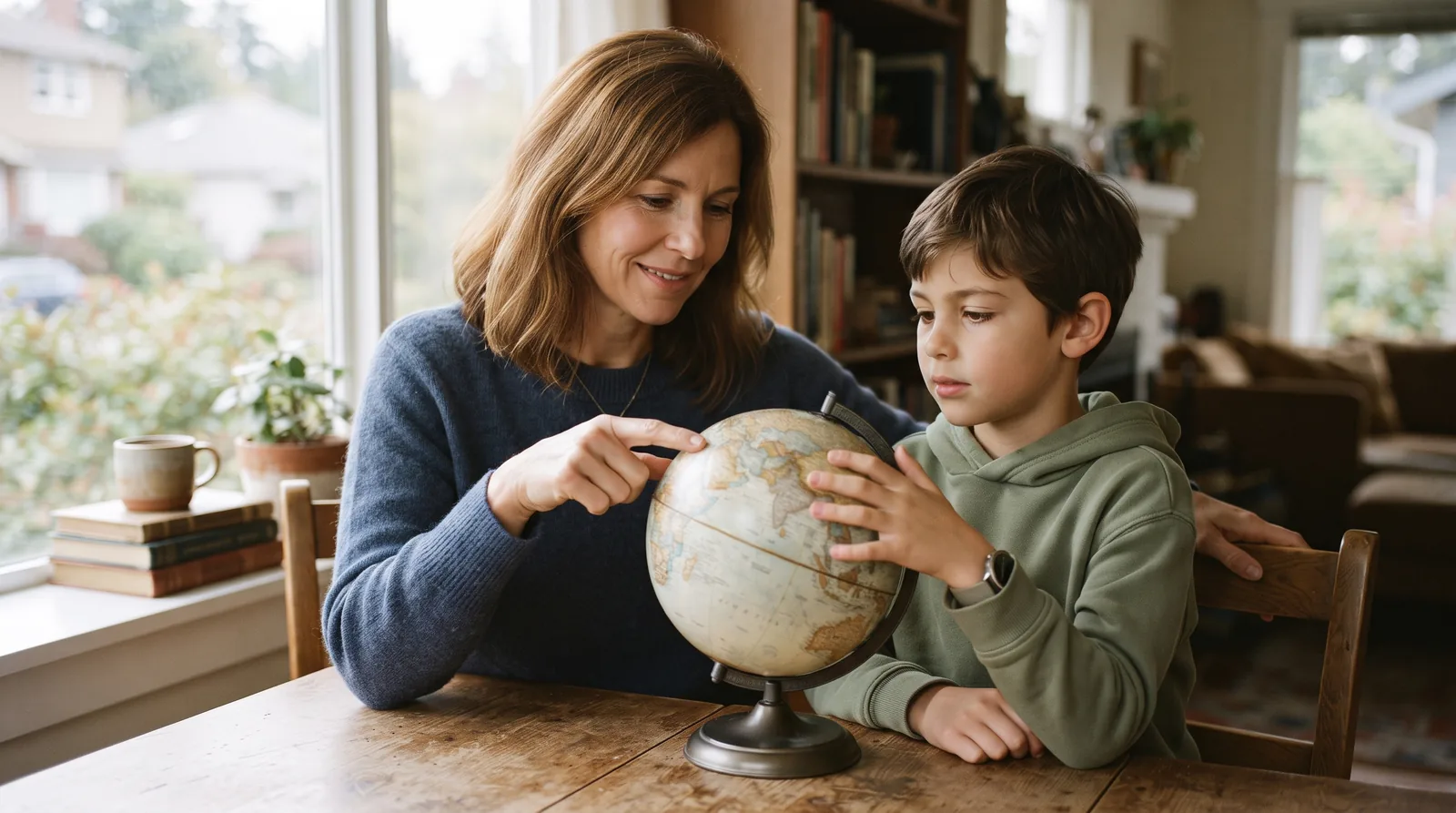
A refugee is someone who has had to leave their home country because it isn't safe to stay, often because of war, violence, or persecution, and who is now looking for safety somewhere else. That one sentence is usually enough for a first question. What actually trips parents up isn't the definition, it's the questions that come right after it: "why can't they just go home," "where do they live now," and "could that happen to us."
This guide covers all three, plus the age-appropriate detail to include and the misconceptions worth gently correcting along the way.
The one-sentence definition that actually works
Start with what they've already heard. "What do you know about refugees?" tells you whether you're correcting a misunderstanding or starting fresh. From there, the simple definition above holds up well for ages 8 to 12: leaving home because it isn't safe, and looking for safety somewhere else. Resist the urge to add political context or statistics up front, a kid's first question is almost always about the people, not the policy.
Why "why can't they just go home" is the real question
This is usually the second question, and it's worth taking seriously rather than brushing past. Kids ask it because "go home" is their own solution to almost every problem. The honest answer: sometimes their home has been destroyed, and sometimes it's still too dangerous to return to, even if the original event that forced them out feels over from the outside. Both are true reasons, and neither requires graphic detail to explain.
"Why did they have to leave?"
"Where do they live now?"
"Could that happen to us?"
How much to say, by age (8 to 12)
| Ages 8 to 9 | Ages 10 to 12 |
|---|---|
| What they needThe simple definition, reassurance about their own safety, and permission to ask more later. | What they needThe definition plus some of the why: what a family might be leaving, and what "looking for safety" actually involves. |
| Sample line"A refugee is someone whose home wasn't safe anymore, so they had to move somewhere new to be safe. You are safe right now." | Sample line"Sometimes a war or serious danger makes it unsafe to stay, so a family leaves everything behind and looks for a country that will let them stay safely." |
| Good follow-upFind the place on a map together, and talk about what they'd want to bring if they had to leave quickly. | Good follow-upTalk about what "asylum" means, or read a kid-appropriate first-person account together. |
Two misconceptions worth correcting gently
Kids sometimes assume "refugee" and "immigrant" mean the same thing, they don't: a refugee is forced to leave by danger, while an immigrant usually chooses to move for other reasons like work or family. Kids also sometimes assume leaving was an easy choice. It rarely is, and naming that it's a last resort, not a first one, helps build the right kind of empathy rather than pity.
"Could that happen to us?"
This question deserves a real answer, not a dismissal. For most families in stable countries, the honest response is that it's very unlikely where you live right now, and that's worth saying plainly rather than avoiding. At the same time, it's fair to acknowledge that big, sudden change is scary to imagine for anyone, and that noticing that feeling is exactly what makes someone capable of caring about people going through it for real. For more on handling the wider conversation about conflict, see how to talk to kids about war in the news.
Words you might hear: refugee, asylum seeker, migrant
News coverage uses several terms that sound alike, and kids (and adults) often mix them up. Here is a simple way to keep them straight:
- Refugee. Someone who has fled their country because of war, violence, or persecution and needs protection somewhere safe.
- Asylum seeker. Someone who has left their country and is asking another country for protection, but whose request hasn't been decided yet.
- Internally displaced person. Someone who has been forced to leave their home but is still living inside their own country.
- Migrant. A broader word for someone who moves to another country, often by choice, for reasons like work, family, or study.
You don't need to teach all four at once. For most 8 to 12 year olds, the part worth getting right is "refugee" and the difference between being forced to leave and choosing to leave.
Simple activities for ages 8 to 12
Understanding sticks better when it's something kids do, not just something they hear.
- Find it on the map. Locate the country someone left and a country where many people now live, and talk about how far apart they are.
- Read a story, not a statistic. A librarian can point you to picture books and middle-grade stories about refugee experiences that suit your child's age. One family's story tends to build more empathy than numbers do.
- Make something welcoming. Draw a welcome card or collect gently used books for a local resettlement group, if there's one near you.
- Use free classroom materials. UNHCR publishes free teaching materials on refugees, asylum and migration, including sets written for ages 6 to 9 and 9 to 12, which work well at a kitchen table too.
Go gently with "imagine you had to leave"
Some activities ask kids to imagine packing a bag and leaving home in a hurry. For sensitive kids this can make the idea feel too close to home. It's often better to skip it, or save it for an older child who is asking for a way to picture it, and to follow it with the reassurance covered above.
If there's a refugee child in your child's class
The most useful thing kids can do is the ordinary thing: include them, be friendly, and let them share their story only if and when they want to. Encourage your child not to ask why the family left or what happened along the way, since those memories can be painful. Asking about favorite games, foods, or what they like to do at recess is a great place to start.
Turn empathy into understanding
The Young Ambassador's Guide walks kids ages 8 to 12 through real, kid-safe case studies of conflict and displacement, structured as a hands-on mission rather than a heavy lecture.
Turning it into empathy, not just information
A definition on its own doesn't build compassion, connection does. Where possible, use stories rather than statistics, a picture book, a first-person account written for kids, or a specific family's story does more than a number ever will. Follow it with a question rather than a conclusion: "what do you think that would feel like" builds more empathy than "isn't that sad," because it asks them to do the thinking themselves.
Sources and further reading
- UNHCR, the UN Refugee Agency: Teaching about Refugees. Free teaching materials on refugees, asylum and migration, including sets for ages 6 to 9 and 9 to 12.
- Save the Children UK: How to talk to your children about refugees. An age-by-age guide for parents.
This guide is general information for parents and educators.