
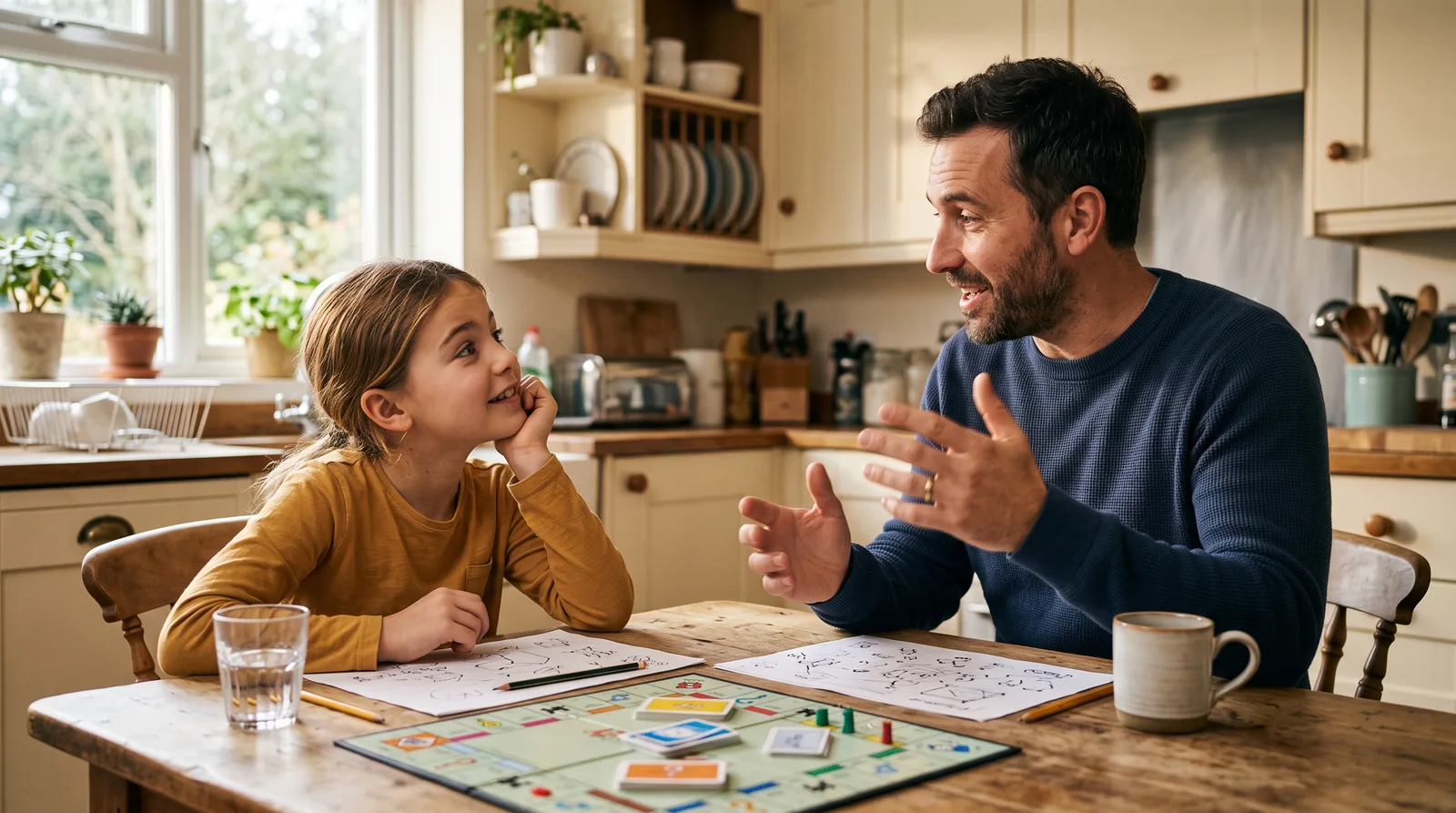
The fastest way to raise a critical thinker isn't a workbook or a formal lesson, it's asking better questions in the moments you already have: at dinner, in the car, watching the news together. Kids ages 8 to 12 build reasoning skills through repetition, not instruction, so five minutes a day of the right kind of question does more than an hour-long talk ever will.
This guide covers what critical thinking actually looks like at this age, the single habit that matters most, five activities that build it without feeling like schoolwork, and what to avoid.
What critical thinking actually looks like at this age
It isn't about knowing more facts. An 8 to 12 year old thinking critically is comparing two options before choosing, predicting what might happen next in a story or situation, explaining their reasoning out loud, and asking where a claim actually came from before accepting it. None of that requires special material, it requires practice, and practice requires you to hand over more of the thinking than usually feels natural.
The one habit that matters most: asking better questions
Parents default to closed questions that have one right answer. Critical thinking grows from open questions that have several possible answers, all defensible with reasoning. The shift is smaller than it sounds:
"What do you think happens next?"
"How do you know that's true?"
"What's another way to look at it?"
Asking one of these instead of just answering a question yourself, even when you already know the answer, is the single highest-leverage habit in this whole guide.
How this looks by age (8 to 12)
| Ages 8 to 9 | Ages 10 to 12 |
|---|---|
| What they can handleComparing two clear options and explaining a simple preference with one reason. | What they can handleWeighing several options, holding two conflicting ideas at once, and revising an opinion with new information. |
| Sample question"Which of these two plans do you think would work better, and why?" | Sample question"What would someone who disagrees with you say, and do they have a point?" |
| Good follow-upLet the choice actually play out when it's low-stakes, then ask what they'd do differently. | Good follow-upLook up one fact together to test a claim, and talk about how you'd verify it. |
Five everyday activities that build it
Compare games
"Would you rather" with a required reason attached turns a silly car-ride game into real reasoning practice, since the answer matters less than the justification.
Prediction prompts
Pause a story, a movie, or even a real situation and ask what happens next and why, then check back afterward to see how the reasoning held up.
A friendly "devil's advocate" turn at dinner
Pick a harmless family decision, like where to go this weekend, and have each person argue for an option they don't actually prefer. It teaches that a position can be argued well regardless of whether you hold it.
Comparing two sources on the same story
For 10 to 12 year olds, pull up two different write-ups of the same news event and ask what's the same, what's different, and why that might be. A weekly version of this is laid out in our homeschool current events routine.
Strategy board games
Games like Connect 4, chess, or a co-op puzzle game build the same muscle as a "lesson" would, without ever feeling like one. The reasoning happens because the game requires it, not because it was assigned.
When they push back on a rule
Pushback isn't automatically disrespect, it can be the exact skill you're trying to build, aimed at you. Within reason, let them make their case, then explain your own reasoning back. "Because I said so" ends the thinking. "Here's why, what would you do differently" keeps it going.
What not to do
Don't just give the answer
Answering immediately is faster, but it trades a chance to build reasoning for a moment of convenience. Ask what they think first, even if it takes longer.
Don't shut down all pushback
A blanket "because I'm the parent" in every disagreement teaches kids to stop questioning rather than to question well.
Don't turn every moment into a lesson
One good question dropped into a normal conversation works better than a deliberate teaching moment kids can feel coming and tune out.
Don't confuse it with cynicism
Critical thinking questions claims to understand them better, it isn't the same as distrusting everything by default. Model curiosity, not suspicion.

Give it a structure kids actually stick with
The Young Ambassador's Guide turns this exact kind of questioning into four missions and four badges kids ages 8 to 12 want to finish.
Turning it into a structured habit
The activities above work best woven into routines you already have, not as a separate program. A weekly board game night, a standing "what do you think" question at dinner, or a shared habit of talking through one news story together each week does more over a year than any single lesson could.
Sources and further reading
- Raising Critical Thinkers (themompsychologist.com). A clinical psychologist and parent on encouraging, rather than silencing, children's natural questioning.
- Facing History & Ourselves: 6 Resources for Teaching Current Events. Classroom resources for discussing current events thoughtfully.
- Nationwide Children's Hospital: Doomscrolling and Brain Rot. Pediatric experts on how constant skimming of headlines can wear down deeper thinking and expose kids to misinformation.
This guide is general information for parents and educators.